


July is Iceland's warmest month and its busiest. The days are still very long, the highland roads are open, and every campsite, café and boat trip is running. It's also when the famous stops are most crowded, so a camper, which lets you visit early in the morning or late in the evening, really pays off. Here's what to expect, using the Icelandic Met Office's averages, and how we'd plan the trip.
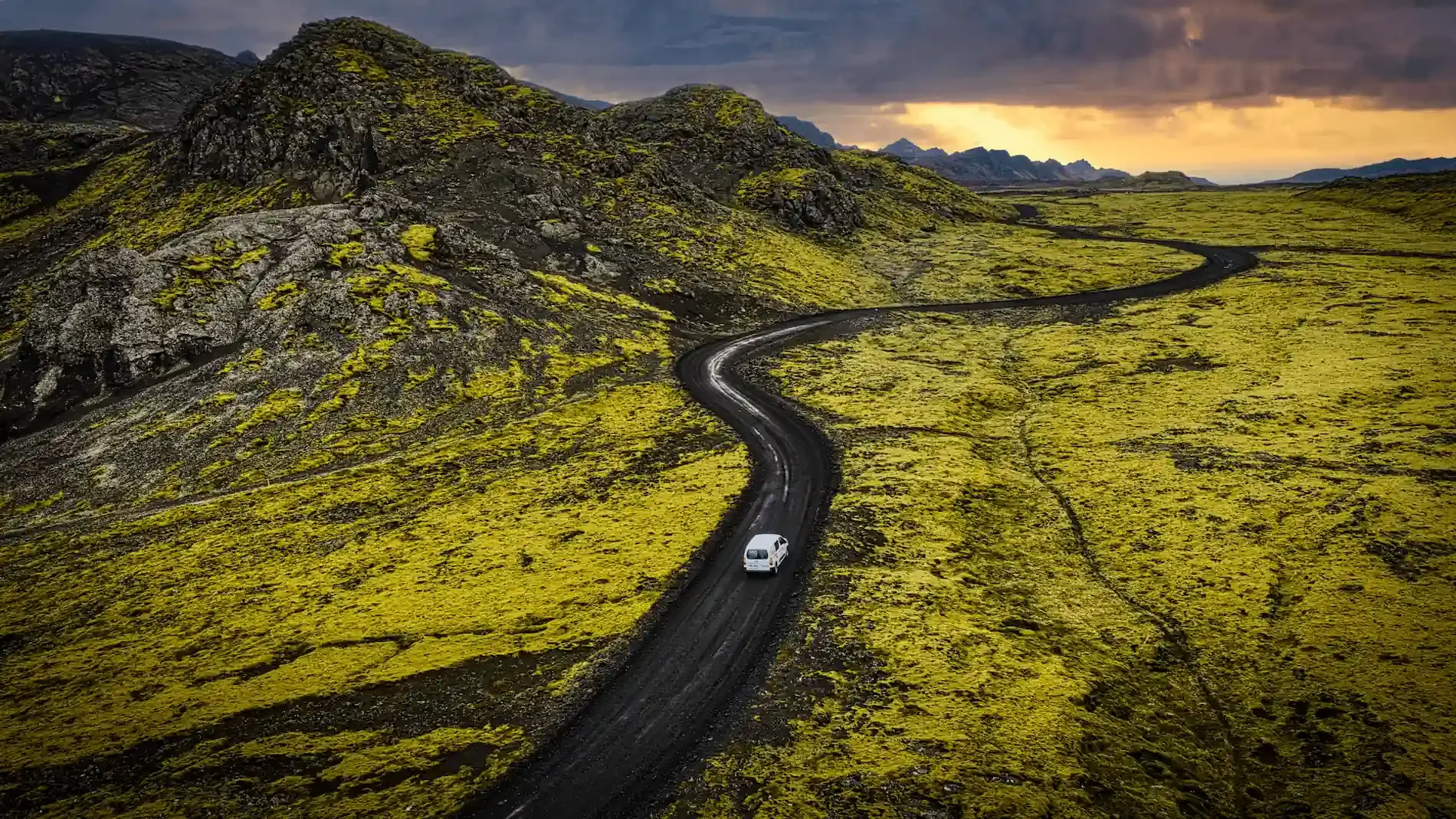
July in Iceland at a glance
| Temperature | The warmest month. Reykjavík averages a high of 14.9 °C and a low of 9.1 °C. Akureyri: 15.1 °C and 8.5 °C. |
|---|---|
| Rain | About 50 mm in Reykjavík and 34 mm in Akureyri on average. |
| Sunshine | About 183 hours in Reykjavík and 153 hours in Akureyri. |
| Daylight | About 21 hours in Reykjavík on 1 July, falling to 18 hours by the end of the month. The nights stay light until the last week. |
| Roads | The Ring Road is clear, and most highland F-roads are usually open by early July. |
| Crowds | Peak season. Campers, popular campsites and tours fill up, so book early. |
Temperatures, rain and sunshine are the 1991 to 2020 averages from the Icelandic Met Office (vedur.is). Daylight comes from a solar calculation for Reykjavík.
What the weather is really like in July
Warm for Iceland means 12 to 17 °C on a typical afternoon, and on the best days in the north and east it can climb past 20 °C. Most days are mild, with a mix of sun, cloud and showers, and the wind can make it feel cooler than the number on the forecast. The south coast is the wettest part of the Ring Road, so if it's pouring around Vík, it's often drier in the north. On the glaciers and in the highlands it's still cold, and fog can roll in fast.
Nights in the camper are usually around 8 to 10 °C, so you'll sleep comfortably with the bedding we provide.
Long days and light nights
On 1 July the sun sets in Reykjavík just before midnight and rises again at about 3 am, and the sky doesn't get properly dark in between. By the end of the month you get a short spell of dusk around midnight. It means you can plan your days around the crowds rather than the light: see Seljalandsfoss or Jökulsárlón at 9 pm and they're far calmer than at midday. There are no northern lights in July, because the sky is too bright.
Driving in July
- Busy roads near the big sights. The Golden Circle and the south coast to Vík are the busiest stretches. Car parks fill up from late morning, so start early.
- Highland F-roads are open, but they're 4x4 only, with gravel, steep sections and unbridged rivers. Our river crossing guide explains what to check. Our 4x4 roof-tent campers are made for this.
- Gravel and loose stones on side roads chip windscreens. Slow down and keep your distance when a car comes the other way.
- Sheep are everywhere in summer, often lying right next to the road.
- Check the weather and roads every morning on vedur.is, road.is and safetravel.is. Summer storms are rarer, but they happen.
More in our guide to driving in Iceland.
Where to sleep
All campsites are open, but in July the popular ones (Skógafoss, Skaftafell, Mývatn) get busy. Most work on a first-come basis, so aim to arrive by early evening, or pick a smaller site a few kilometres away. Our campervan map shows every campsite, and our guide to where you can sleep explains the rules. In a camper you sleep at campsites, not by the roadside.
Things to do in July
- The full Ring Road: July is the easiest month for it. Our Ring Road guide has distances and how many days you need.
- The highlands: Landmannalaugar's colourful mountains and natural hot spring, Þórsmörk and Kerlingarfjöll are all reachable in a 4x4. See our highland guide.
- Puffins: still nesting on the cliffs all month. Our puffin guide lists where to see them.
- Whale watching from Húsavík, Akureyri and Reykjavík.
- Lake Mývatn and the north: warmer and drier than the south on many days. Bring a head net for the midges by the lake.
- The Westfjords: the roads are at their best in July. Our Westfjords guide has the details.
Beating the crowds in July
- Visit the famous stops before 9 am or after 7 pm. With the light nights, evening visits work beautifully.
- Do the Golden Circle in reverse, starting at Gullfoss, or on the evening you pick up the camper.
- Spend more time in the north and east, where it's much quieter than the south coast.
- Book your camper early. July and August are the busiest months in Iceland, and the most popular campers go first.
A 10-day July route
We'd drive the full Ring Road in 10 days, with one highland day if you've got a 4x4: Golden Circle, the south coast to Jökulsárlón, the East Fjords, Lake Mývatn and the north, then back through the west, with a spare day for weather. Our Ring Road itinerary has it day by day.
What to pack
- A waterproof jacket and trousers (it will rain at some point)
- A fleece or wool layer for evenings and glacier stops
- Walking shoes that can get wet, and sandals for the hot pools
- An eye mask for the light nights
- A head net if you're going to Mývatn
- Sunscreen and sunglasses
Bedding, a cooking kit and a camping table and chairs come with every Foxie camper. Our packing list has the rest.