

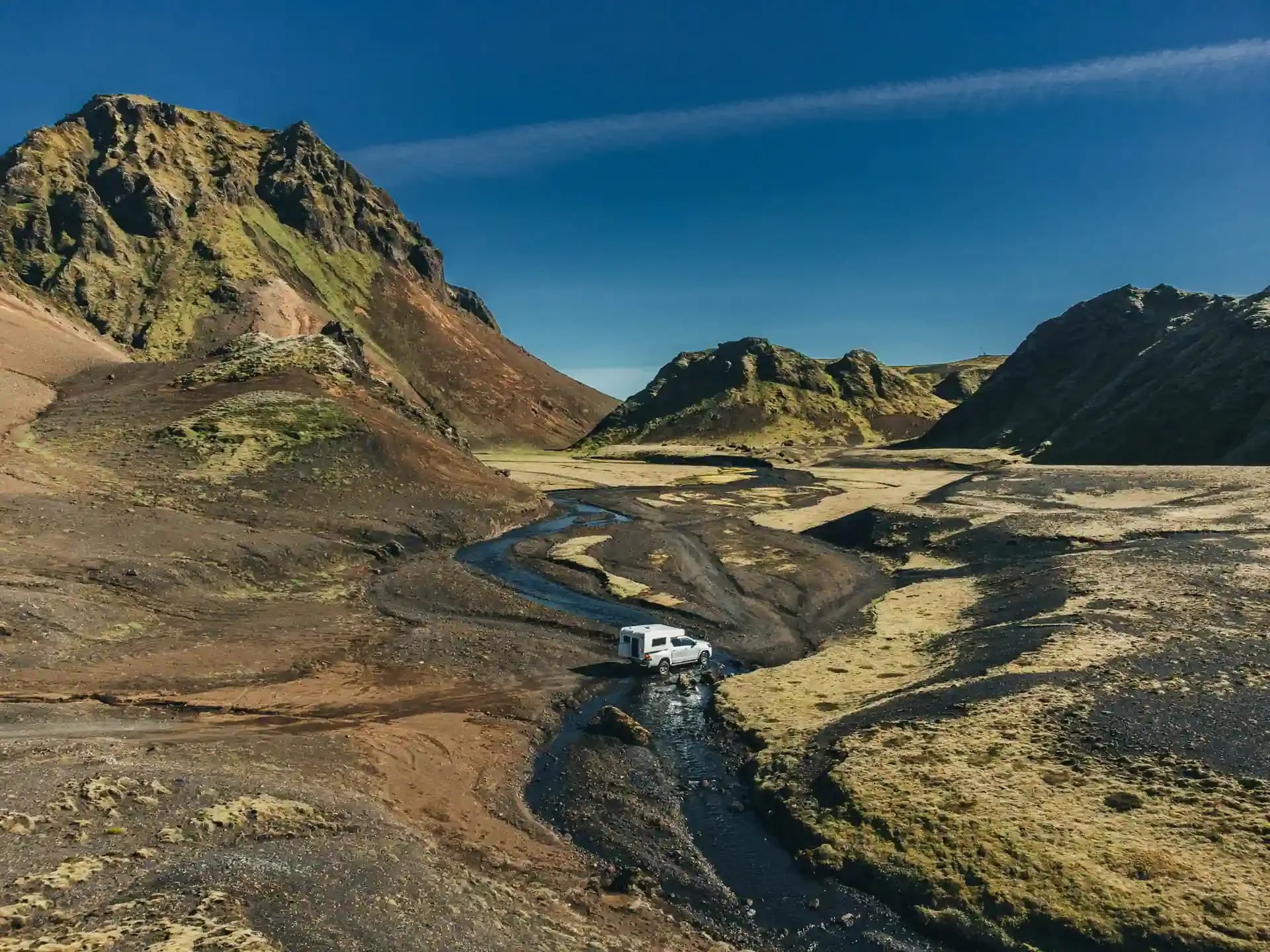
Crossing Rivers in Iceland: A 4×4 F-Road Guide
Drive Iceland's Highlands long enough and the tarmac runs out. On the legal F-roads — the mountain routes that, by law, require a 4×4 — you'll eventually reach a river with no bridge over it. The first time, it's intimidating: the water always looks deeper from behind the wheel than it did from the bank.
Here's the honest version from a rental team that fields these calls every summer: most river crossings in Iceland are manageable if you slow down, inspect first, and know your vehicle's limits — and a handful of them are genuinely dangerous and cost travellers a flooded engine every season. This guide walks you through how to tell the difference, the exact line to drive, and the timing and insurance details that catch people out.
The short version
- You need a proper 4×4 with low range — never a 2WD.
- Cross in the early morning, when glacial rivers run lowest.
- Get out and check depth, riverbed, and current on foot before you drive.
- Go slow and steady on a diagonal, downstream line — never floor it.
- Water damage isn't covered by insurance — if in doubt, turn back.
Read this first: insurance, the law, and your rental agreement
Before any of the technique matters, three facts every renter needs:
- F-roads legally require a 4×4. A 2WD car — or a 4×4 driven onto an F-road it isn't rated for — is both unsafe and uninsured the moment it's there.
- Water damage is almost never covered. Standard rental insurance (CDW, and usually even the top tiers) excludes water entering the engine and damage to the underbody. A single failed crossing can turn into one of the most expensive mistakes of your trip.
- Check the agreement on whatever 4×4 you rent. Some vehicles and rentals permit F-road river crossings; others prohibit them outright, and the fine print on water damage varies. Know where yours stands before you set off — if you book a Highland-ready 4×4 through us, we'll point you to exactly what its terms cover.
The golden rule that sits above every tip below: if there's genuine doubt that a crossing is safe, turn back. No waterfall or hot spring is worth it. Rivers rise, riverbeds shift, and the safest drivers in Iceland are the ones comfortable saying "not today."
Can you cross rivers with a rental camper?
Only in the right vehicle. River crossings are for a proper 4×4 with real ground clearance and a low-range gearbox — not a raised 2WD or a soft crossover. Our own campers are ideal for the Ring Road and Iceland's paved sights; and if your route heads into the Highlands, we can arrange a Highland-capable 4×4 for you through our partner network — just ask our team and we'll match you to a vehicle rated for the F-roads and the crossings on your itinerary. If rivers aren't on your plan, a 2WD camper is perfectly happy on the Ring Road — no F-road, no crossing, no risk.
Timing: the tip most guides skip
Icelandic Highland rivers are mostly glacial, and glacial rivers change through the day. Overnight, cold slows the melt and the water drops; by warm afternoon — and after rain — the same crossing can be running much higher and faster.
Cross in the early morning whenever you can. A river that's an easy wade at 8 a.m. can be a no-go by 5 p.m. on a sunny day. Check road.is for F-road status and vedur.is for weather before you leave, and factor rain from the previous 24 hours into your plan.
The six checks before you enter the water
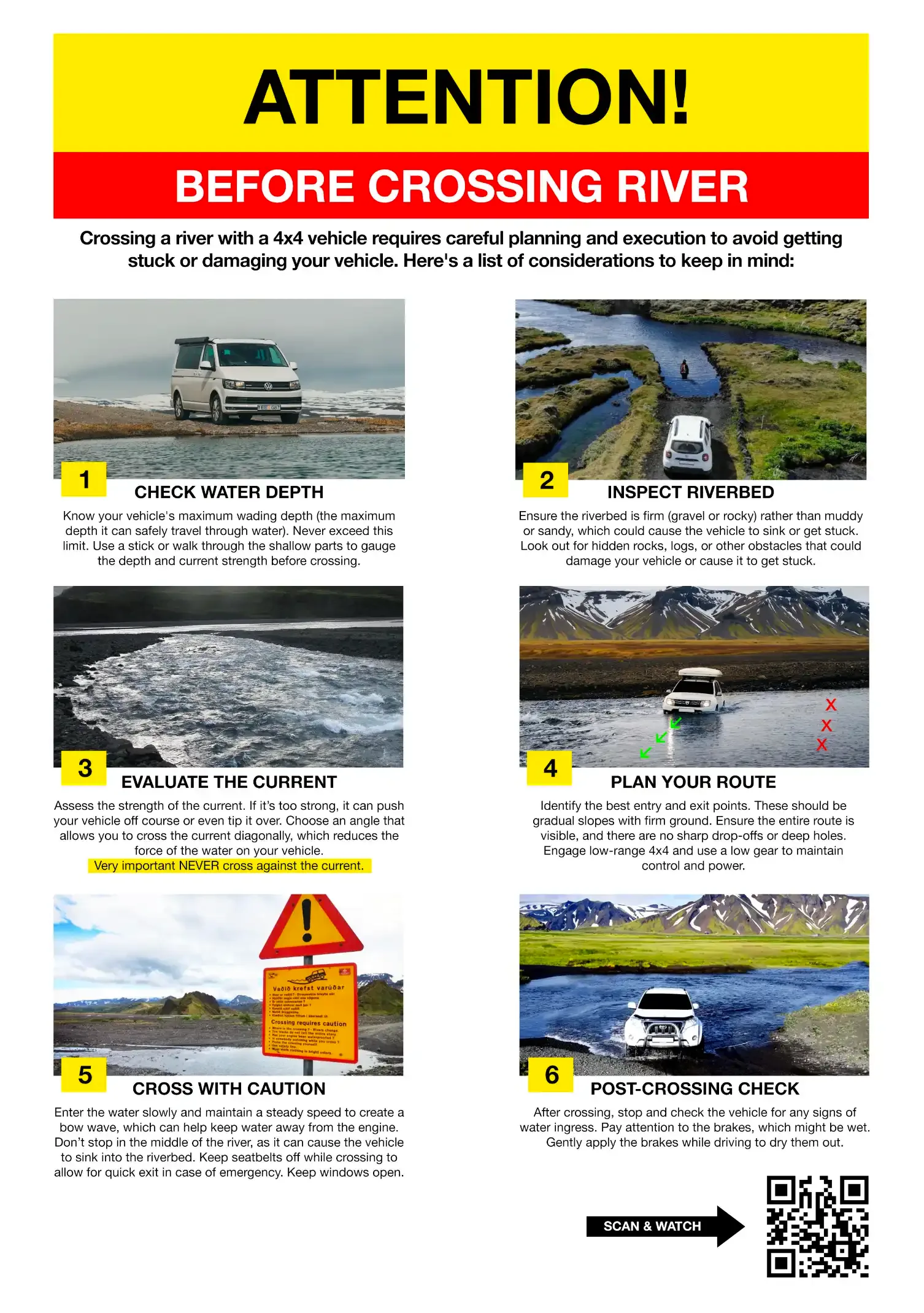
Treat every crossing as a process. Never roll straight from the road into the river. Work through these, one at a time.
1. Depth
Know your vehicle's maximum wading depth and never exceed it — ask the provider, or ask us and we'll confirm it for any 4×4 we arrange. A useful trick: relate that limit to your own body — knee, mid-thigh, hip — so you have an instant reference standing in the water. Then measure the shallow line with a stick, or wade it if it's safe, before the vehicle gets wet.
2. The riverbed
Depth is only half the story; what's underneath decides whether you make it. Walk the intended line and feel the bottom. Firm gravel or rock is good; soft sand or mud is where vehicles sink and stick. Feel for hidden holes, rocks, and logs that could catch the underbody.
3. The current
A current that looks mild can still push a vehicle off its line, and a strong one can float and carry it. Watch how fast the water moves. When it's clearly manageable, cross diagonally, angled downstream with the flow — never straight into the current, which forces water up toward the hood and engine bay. If the current worries you, don't cross.
4. The line — entry, route, exit
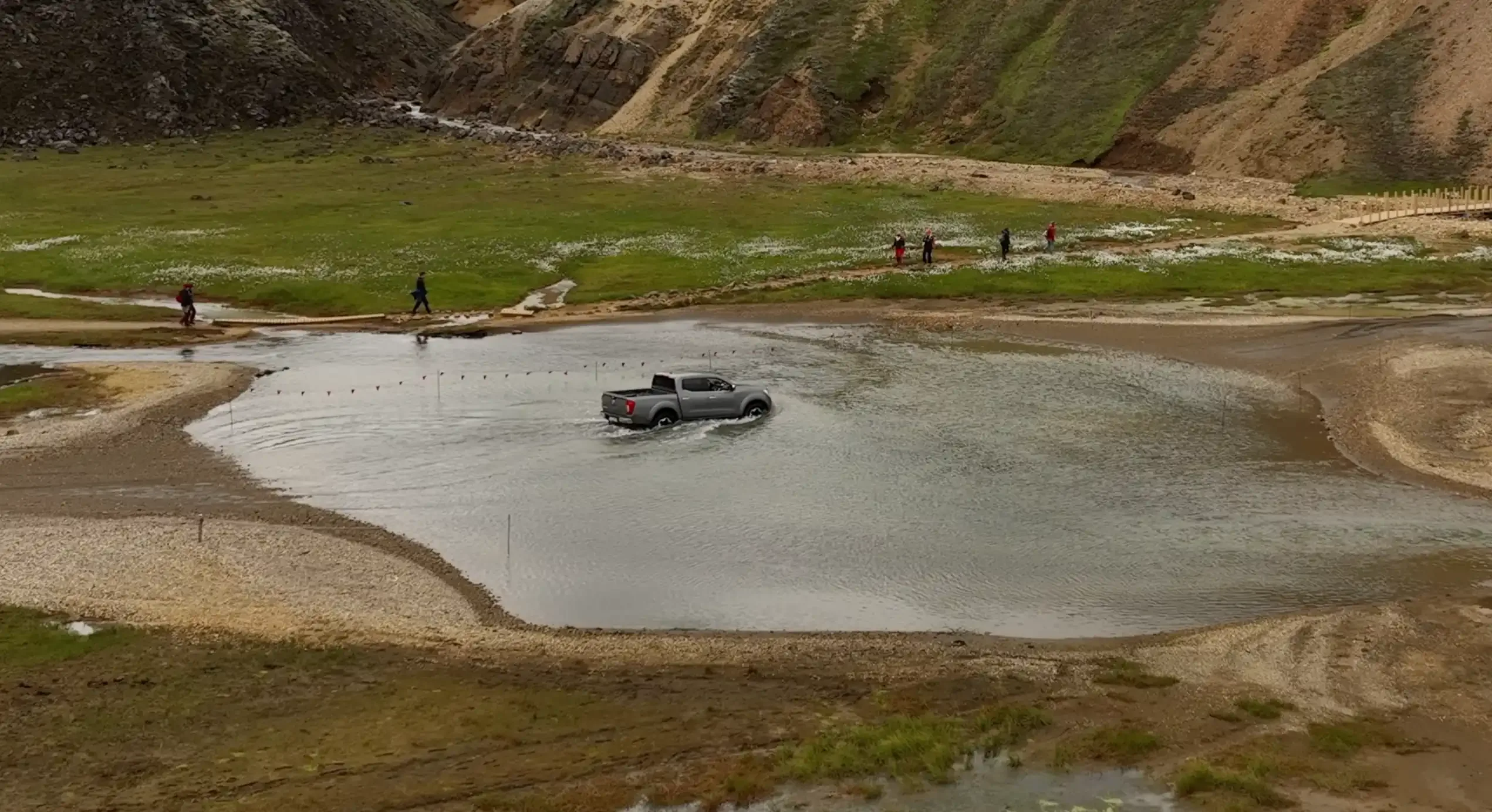
Pick your entry point, the path across, and the exit before you move. Look for gradual banks and firm ground, and make sure the whole line is visible with no sudden drop-offs. Many marked crossings have poles or a rope line showing the safest route — follow them as closely as conditions allow.
5. Set up the 4×4
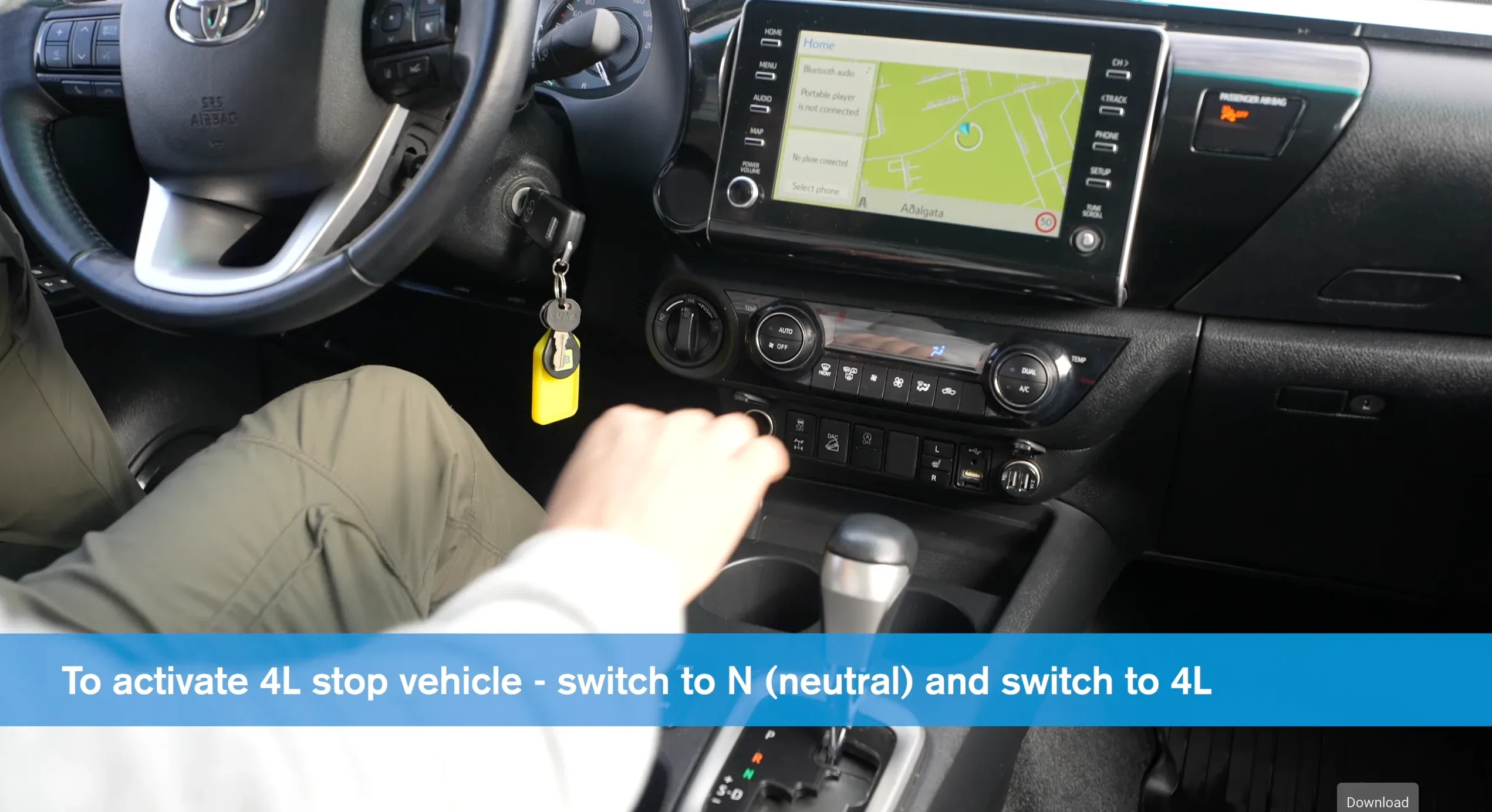
Before entering, engage low range (4L) and select a low gear (usually first). You want steady, controlled power without having to rush.
6. Final gut-check
Windows down, seatbelts off only as a precaution for a fast exit if something goes wrong. Take one last honest look. Still confident? Go. Any real doubt? Turn back — that decision has saved far more trips than it's cost.
How to cross — calmly
Enter slowly and hold a steady, unbroken pace. That creates a small bow wave that pushes water away from the engine. Don't stop mid-river (you can sink or lose traction), and — the classic mistake — don't stab the accelerator when it gets deep. Flooring it digs the tyres in, throws off your line, and throws water at the hood. Trust your prep, stay in low gear, and follow the line you chose.
- Enter slow, keep the pace consistent.
- Hold the diagonal, downstream line.
- No stopping mid-crossing unless it's an emergency.
- No sudden acceleration as it deepens.
- Windows down, belts off — just in case.
The moment you reach the far bank
You're not quite done. Pull out, ideally onto a slight incline, and give any trapped water a moment to drain. Then dry the brakes: apply them gently as you drive off for the first stretch until they bite normally again. Check for any sign of water where it shouldn't be before you pick up speed.
Which Icelandic F-roads actually have crossings?
A few real-world markers so you know what you're walking into:
- F249 to Þórsmörk ends at the Krossá — one of the most dangerous crossings in the country. It's deep, braided, and constantly changing; most rentals prohibit it and it's best left to modified super-jeeps and the highland buses.
- F208 to Landmannalaugar (the southern approach) has genuine crossings that demand a capable 4×4 and good judgment.
- F35 (Kjölur) is now largely bridged over its major rivers, which makes it one of the more approachable Highland routes.
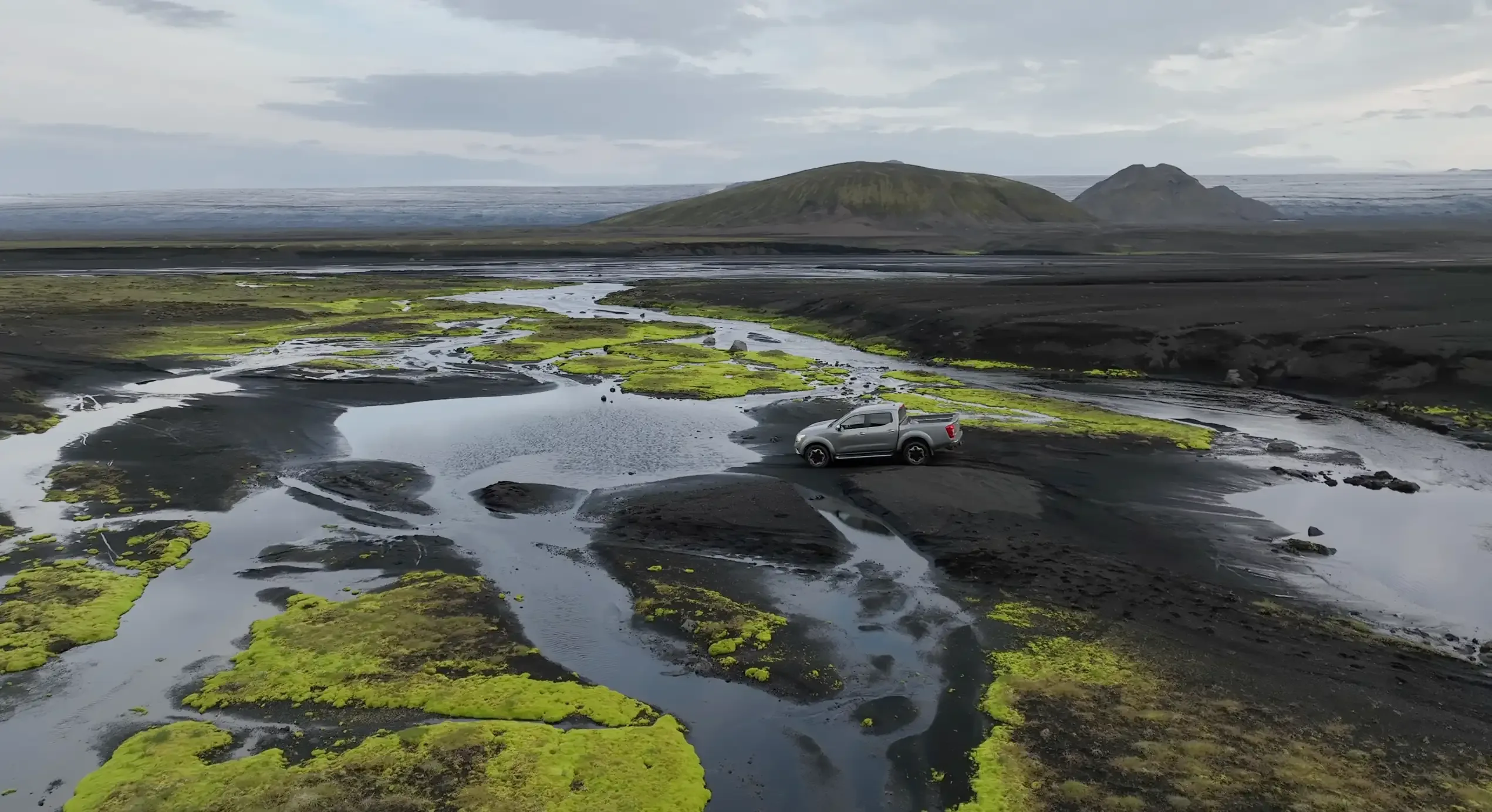
Planning a Highland trip? Talk to our team about a 4×4 that's built for these routes.
Quick river-crossing checklist
- Vehicle limit: confirm max wading depth; never exceed it.
- Depth & current: measure and assess from a safe spot.
- Walk the route: firm ground, no hidden holes, rocks, or mud.
- Choose the line: gradual entry/exit; follow marker poles.
- Set up: low range on, low gear selected.
- Cross steadily: slow, consistent, no sudden throttle.
- Emergency-ready: windows down, belts off.
- After: drain, inspect, gently dry the brakes.
- Timing: cross in the morning when rivers are lowest.
Frequently asked questions
Are river crossings covered by rental insurance in Iceland?
No — water damage to the engine and underbody is excluded from standard rental insurance in Iceland, including most premium tiers. Always check your rental agreement before attempting any crossing.
What's the best time of day to cross a river in Iceland?
Early morning. Highland rivers are glacial, so they run lowest overnight and rise through warm afternoons and after rain. A crossing that's easy at 8 a.m. can be impassable by evening.
Can I cross rivers with a 2WD rental car?
No. F-roads and their river crossings legally and practically require a 4×4 with proper clearance and low range. A 2WD is fine for the Ring Road and paved sights — just not the Highlands.
What should I do if my vehicle stalls or floods mid-river?
Do not restart the engine — that draws water in and turns a recoverable situation into engine damage. Get everyone out safely (this is why windows are down and belts off), and call for assistance. Prevention is everything, which is why you inspect and turn back when in doubt.
Which Icelandic F-roads have river crossings?
Many mountain F-roads include at least one ford. Well-known examples are F208 and F210 in the Fjallabak area, and F249 to Þórsmörk — which ends at the notoriously dangerous Krossá. Others, such as much of F35 (Kjölur), are now bridged. Always check current conditions on road.is before you set off, as crossings change with weather and season.
Is it legal to cross rivers in Iceland?
Yes — fording a river at a marked crossing on a legal F-road is permitted in a suitable 4×4. What's illegal is driving off-road or off-track anywhere in Iceland, which carries heavy fines. Beyond the law, check your rental agreement: some providers prohibit river crossings outright.
Ready for the Highlands?
The right camper turns Iceland's interior from intimidating to unforgettable. If a Highland, F-road trip is on your list, talk to us and we'll sort you a 4×4 that's up to it from our partner network. Sticking to the Ring Road? Our own campers are ready when you are. Either way, if you've got a route in mind and aren't sure a crossing is doable, message our team — we drive these roads and we're glad to talk it through before you commit.
Written by the Foxie Campers team in Reykjavík. Last updated August 2026.