


The Ring Road (Route 1, or Hringvegur in Icelandic) is the one road that goes all the way around Iceland. It's about 1,322 km long, it's paved the whole way, and it links almost everything people come to see: the south coast waterfalls, the glacier lagoon, the East Fjords, Lake Mývatn and Akureyri in the north. We hand over campers for this trip every week at our desk in Keflavík, and these are the questions guests ask us most before they set off.
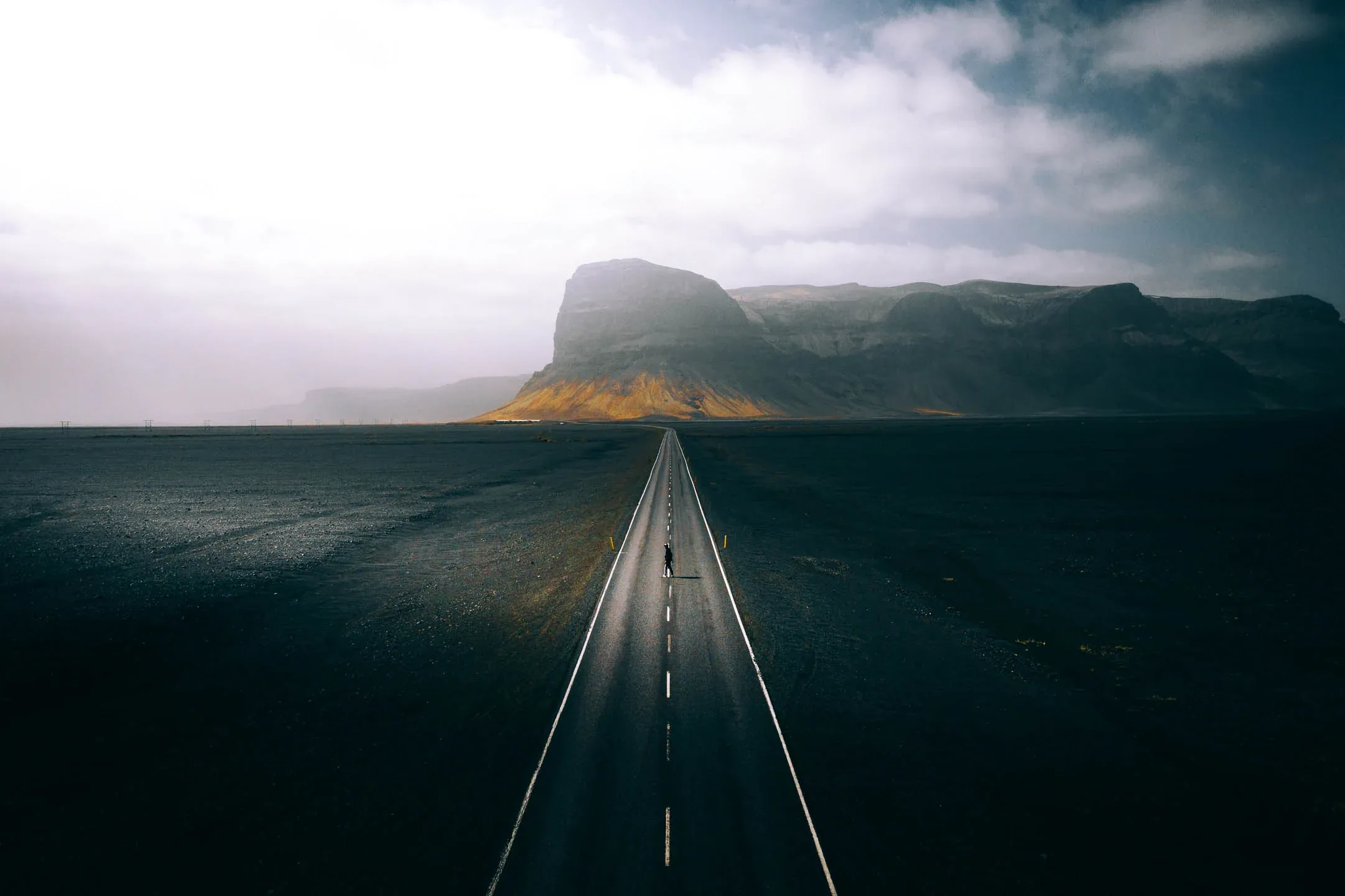
The Ring Road at a glance
| Length | About 1,322 km around the island. A full loop from Reykjavík and back is about 1,350 km, and about 1,450 km if you start and finish at our desk in Keflavík. |
|---|---|
| Driving time | About 20 hours behind the wheel for the whole loop, without stops. In real life, with photo stops, fuel and walks, plan on 3 to 5 hours of driving a day. |
| Road | Paved all the way round. Mostly one lane in each direction, with narrow shoulders and quite a few one-lane bridges in the south-east. |
| Speed limit | 90 km/h on the open road, 50 km/h or lower in towns. |
| Open | All year. It's cleared in winter, but stretches can close for hours or days in a storm. |
| Vehicle | Any 2WD camper or car is fine. You only need a 4x4 for the highland F-roads, which aren't part of the Ring Road. |
The drive times in this guide come from a routing calculation on 18 November 2026, town to town at the speed limit. Real days are slower, and that's the point of the trip.
How long is the Ring Road?
Route 1 itself is about 1,322 km. The road opened all the way round in 1974, when the bridges over the Skeiðarársandur glacial plain in the south-east finally closed the gap. These are the distances between the main stops if you drive it counterclockwise from Reykjavík, along the south coast first:
| From | To | Distance | Driving time |
|---|---|---|---|
| Our desk, Keflavík | Reykjavík | 48 km | 45 min |
| Reykjavík | Selfoss | 59 km | 1 h |
| Selfoss | Vík | 130 km | 2 h |
| Vík | Kirkjubæjarklaustur | 73 km | 1 h |
| Kirkjubæjarklaustur | Jökulsárlón glacier lagoon | 123 km | 1 h 45 min |
| Jökulsárlón | Höfn | 65 km | 1 h |
| Höfn | Djúpivogur | 103 km | 1 h 30 min |
| Djúpivogur | Egilsstaðir (through the East Fjords) | 158 km | 2 h 20 min |
| Egilsstaðir | Lake Mývatn | 166 km | 2 h 20 min |
| Lake Mývatn | Akureyri | 84 km | 1 h 15 min |
| Akureyri | Blönduós | 145 km | 2 h 10 min |
| Blönduós | Borgarnes | 171 km | 2 h 25 min |
| Borgarnes | Reykjavík | 76 km | 1 h 15 min |
The longest empty stretch is between Lake Mývatn and Egilsstaðir: 166 km across a high, bare plateau with very little on the way. Fill up before you leave Mývatn, and in winter check the road report for that stretch first, because it's one of the first to close in a storm.
How many days do you need for the Ring Road?
You can drive the whole loop in 20 hours, but you'd see almost nothing. This is how we'd think about it:
| Days | What it's like |
|---|---|
| 5 days | We don't recommend it. You'd drive about 4 hours every day and still have to rush the stops. With 5 days, do the Golden Circle and the south coast to Jökulsárlón instead. |
| 7 days | Possible in summer, with about 3 hours of driving a day and early starts. You'll see the big sights, but there's no spare day if the weather turns. |
| 8 to 10 days | What we recommend for a first trip. Time for the Golden Circle, walks at the waterfalls, a dip in a hot pool and one spare day. |
| 12 to 14 days | Room for the side trips the Ring Road skips: the Snæfellsnes peninsula, the Diamond Circle in the north (Húsavík, Ásbyrgi and Dettifoss) or a few days in the Westfjords. |
Our 7 to 10 day Ring Road itinerary has the route day by day, with where to stop and where to sleep.
What the Ring Road doesn't include
A lot of people expect to see these "on the way", but they're detours:
- The Golden Circle (Þingvellir, Geysir and Gullfoss) is inland from Route 1. Most people add it on day 1 or 2, before heading along the south coast. See our Golden Circle guide.
- The Snæfellsnes peninsula and Kirkjufell are about two hours north-west of Borgarnes, off the road.
- The Westfjords aren't on the Ring Road at all. They need at least 3 or 4 extra days. Our Westfjords guide explains why.
- Dettifoss, Ásbyrgi and Húsavík are north of Lake Mývatn, on a loop of their own. Our North Iceland guide covers it.
Plenty is right on Route 1 or a few minutes off it: Seljalandsfoss and Skógafoss, Reynisfjara beach near Vík, Skaftafell, Jökulsárlón, the East Fjords, the steaming ground at Námaskarð, Lake Mývatn and Goðafoss.
Clockwise or counterclockwise?
There's no right answer, and we'd decide on the day you pick up the camper, not months before.
- Counterclockwise (south coast first) is what most people do. You see the waterfalls, beaches and glacier lagoon while you're fresh, and the south is where the campsites and services are busiest and easiest.
- Clockwise (north first) leaves the south coast for the end. It's a good choice in summer if the forecast for the south is wet at the start of your trip.
Our advice: look at the forecast on vedur.is for the first three days and drive towards the better weather. Ask us at the desk and we'll tell you what we're seeing that week.
Driving the Ring Road: what to know
- One-lane bridges. Look for the sign Einbreið brú. Slow down, and if a car is already on the bridge or closer to it than you, let it cross first.
- Never stop on the road for a photo, the northern lights or sheep. Pull into a car park or a marked lay-by. The shoulders are narrow and soft.
- Sheep and lambs wander onto the road from late spring to autumn, often in pairs. If you see one on the verge, slow down: the other is usually across the road.
- Fuel. Most stations have card pumps that work around the clock, and you'll need a card with a PIN. Don't let the tank drop below half in the east and the north. Our gas station map shows every station.
- Two tolls. The Vaðlaheiði tunnel near Akureyri and the Hornafjörður bridge are paid online, not at a booth. Our guide to parking, tolls and fines explains how, so you don't get a fine afterwards.
- Check the road every morning on road.is (or call 1777) and look at safetravel.is for warnings. Wind is the danger more often than snow, especially in the south-east.
There's more in our full guide to driving in Iceland.
Can you drive the Ring Road in winter?
Yes, the road is open all year and it's cleared, but winter changes the plan. In December you only get 4 to 5 hours of daylight in Reykjavík, and less in the north. The mountain stretches, like Holtavörðuheiði, Öxnadalsheiði and the plateau between Mývatn and Egilsstaðir, can close for hours or a day or two when a storm comes through.
From November to February we'd only drive the full loop with at least 10 days and a couple of spare days, short driving days and a flexible plan. If you've got a week, the south coast as far as Jökulsárlón is the better winter trip. Every Foxie camper runs on studded tyres in winter, and most have a diesel night heater. Our winter campervan guide has the details, and our month guides start with Iceland in November.
Where to sleep on the Ring Road
In a camper, you sleep at campsites. It's the rule in Iceland, and there are campsites in or near almost every town on Route 1, often with showers, toilets and a kitchen. In summer you can usually just turn up. From October to April many are closed, so check before you go. Our campervan map shows them all, and our guide to where you can sleep explains the rules.
What does a Ring Road trip cost?
The camper is the biggest part. On top of that, a full loop of about 1,450 km from our desk and back uses roughly 100 to 130 litres of fuel in a small camper, depending on the camper and how you drive. Campsites usually cost about 30 to 50 EUR a night for two. Our campervan trip cost guide adds it all up with real prices.
Which camper for the Ring Road?
Any of our campers can drive the whole Ring Road. The real question is how much room you want and when you're going. For two people a compact camper is easy to drive and park. For winter, pick one with a diesel night heater. You only need one of our 4x4 roof-tent campers if you also want to drive the highland F-roads, and those are open only in summer. You'll find the whole fleet, with live prices, on our campervan rental page.